

Hiring apprentices or training people in your existing team is one of the most effective ways to grow skills, boost productivity, and support your long-term goals as a business.
More and more employers are turning to apprenticeships as effective ways to train their staff and expand their team (see latest GOV.UK statistics).
Here are 8 things we often get asked by employers that are important to know before making a decision about hiring apprentices.
1. What is an apprentice?
An apprentice is someone who works in your business while gaining a formal qualification through structured, government-approved training.
They could be:
A new recruit in an entry-level role
An existing employee who’s developing their skills or moving into a new position
Apprenticeships combine real work with regular learning, delivered by a provider like Central Training Academy.
2. What skills does an apprentice need before they start?
Apprentices don’t need to be fully formed — they need the right mindset. Things like:
A willingness to learn
Communication and teamwork skills
Motivation and reliability
Many of these develop during the programme. Apprenticeship training includes soft skills like time management, problem solving and confidence — not just technical knowledge.
At Central Training Academy, our tutors work closely with apprentices and line managers to support growth from day one.
3. How much does it cost to hire or train an apprentice?
For most small to medium employers: Training is fully government-funded, you only pay the apprentice’s wage, and there are no recruitment or training fees from us. If training an existing staff member, they keep their current salary.
For larger levy-paying employers, training is funded directly from your Apprenticeship Levy contributions via your Apprenticeship Service account with no extra costs required unless levy funds are exhausted.
Unsure about costs or eligibility? Get in touch via our contact form for personalised free advice.
National Minimum Wage Rates for Apprentices (from April 2026)
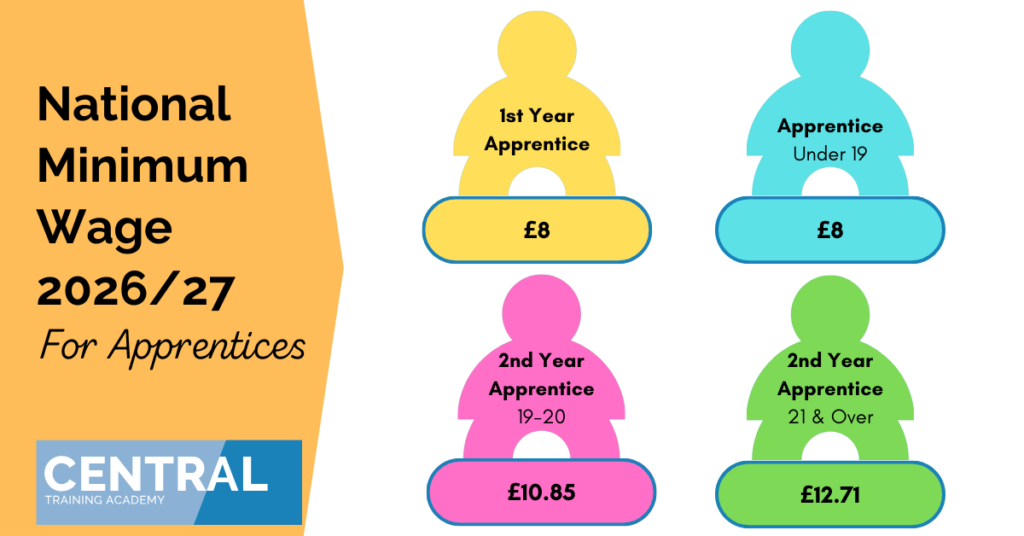
First year apprentices and apprentices aged under 19 are paid the national minimum wage for an apprentice.
Apprentices aged 19 and over who have completed their first year are paid the minimum wage for their age group.
4. Can I train someone already employed?
Yes — and this is one of the most effective uses of apprenticeships.
You can use apprenticeships to:
Upskill loyal staff in new areas
Support promotions and career development
Build specialist internal capability (e.g. compliance, fraud, leadership)
For example, a team leader might enrol on a Level 3 Team Leader apprenticeship, or a staff member in risk or audit could take on a Level 4 Counter Fraud Investigator programme.
This approach boosts retention and helps staff grow within your organisation.
5. How long does an apprenticeship take?
Most apprenticeships last between 8 and 24 months, depending on the level and prior experience.
From 2025, some apprenticeships can now be completed in as little as 8 months, where the learner has relevant prior learning.
Common durations:
Level 2–3: 12–15 months
Level 4: 18–24 months
Training time includes approx. 6 hours per week of structured learning.
6. Will it disrupt the working day?
Not at all — apprenticeships are designed to fit around your business.
Training is often:
Workplace-based
Delivered online or in short sessions
Linked to real job responsibilities
This means minimal disruption to your daily operations. Apprentices apply their learning directly to the work they’re doing.
7. What support will I get as an employer?
You’re not expected to figure it out alone.
Central Training Academy will support you with:
Programme selection
Enrolment and compliance
Regular progress reviews
A dedicated tutor and contact point
Employer guidance throughout the journey
We’re here to make the process simple and effective for both you and your apprentice.
Ready for support with your next apprenticeship? Submit your details or contact us here.
8. What roles or staff can benefit from an apprenticeship?
From reception and front-of-house roles staff, Junior or developing team leaders to staff in governance, policy and risk, or customer service and admin, apprenticeships now support a wide range of roles and career stages.
If a role involves growth or structure, an apprenticeship may be the perfect fit.
We currently deliver:
Explore more about apprenticeships on the official GOV.UK Apprenticeship Service page.
Ready to hire an apprentice or upskill your team?
Start by talking to our team. With over 40 years in the training industry, we can help you:
Choose the right apprenticeship
Understand your funding
Decide whether to hire or train internally
Set up enrolment or recruitment
📩 Submit the contact form below for free recruitment and training support.